
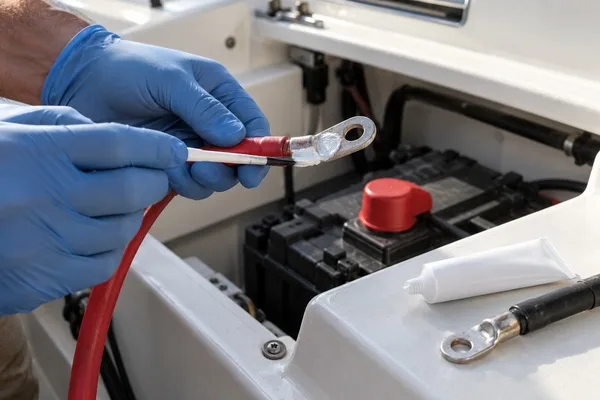
Effective corrosion prevention on electrical connections means making a clean, tight metal-to-metal joint first, then sealing it so salt air and moisture can't reach the contact surfaces. Tef-Gel does that sealing job well, as long as it protects the joint instead of sitting between the conductors.
Done right, the connection stays low resistance for years instead of failing a month after the boat leaves the shop. Questions on a specific application? Contact our team or call (561) 320-3522.
How does salt air attack terminals, lugs, and grounds?
Salt-laden moisture settles on every exposed connection, and wherever two metals meet with an electrolyte present, corrosion starts. Oxides build up between the contact faces, resistance climbs, and the joint starts to heat under load.
The symptoms are familiar to anyone who works on boats. Intermittent electronics, slow cranking, lights that dim when the bilge pump kicks on, and voltage drop that shows up only under load. Often the terminal looks fine from the outside while the contact face underneath has turned to powder.
Dissimilar metals make it worse. A tinned copper lug against a lead battery post, a stainless bolt through an aluminum bracket, or a ground stud on an aluminum hull all set up galvanic action that speeds the attack.
Grounding points take the most abuse. They often sit low in the boat, near bilge moisture, and a bad ground can make a perfectly good component look faulty.
How does Tef-Gel protect a joint without insulating the contact?
Tef-Gel is a PTFE-based compound that seals out water and oxygen. PTFE is not a conductor, so the gel's job is to protect the joint, not to carry current. The current path should be clean metal on clean metal, tightened properly, with the gel sealing around and over it.
That's the key to using it correctly. A heavy glob packed between a lug and a post can interfere with the contact. A connection made dry and tight, then coated, keeps full contact while the gel blocks the moisture that causes oxide buildup.
It also stays put. Tef-Gel contains 40% solid PTFE and 0% volatile solvents, so it won't evaporate, dry out, or cold flow. It's waterproof, non-hardening, and has a 590°F flash point, which matters near engines and in hot engine rooms.
For the full background on the product and where it's used across a boat, see our about Tef-Gel page.
What's the step-by-step for a lasting, low-resistance connection?
Clean, assemble dry, torque, then seal. Each step matters, and skipping prep is the most common reason a coated joint still fails.
Start by disconnecting power and removing the terminal or lug. Clean both contact surfaces to bright metal with a terminal brush or abrasive pad, and remove all oxide, old grease, and residue. Replace any lug with green corrosion creeping up the wire, since that damage won't clean out.
Assemble the connection clean and dry. Tighten to the battery or component manufacturer's torque spec. Undertightened joints loosen and arc, while overtightened ones crack lugs and strip soft lead posts.
Then apply a thin, even film of Tef-Gel over the assembled joint, covering the lug, nut, exposed threads, and post so no bare metal is left open to the air. A small brush works well. A little goes a long way, and you can clean up excess with mineral spirits.
For most service trucks, the Tef-Gel TG-1 (20cc tube) is the easy everyday size. It fits in a tool bag and covers plenty of terminals between restocks.
Why does Tef-Gel outlast generic pastes?
Many generic greases and pastes break down in the marine environment. They wash out in a wet bilge, dry and crack in engine room heat, or harden into a crust that traps moisture against the metal. Tef-Gel is non-hardening and solvent-free, with a 10-year shelf life.
We worked with a technician who always wore the same "Gone Fishin'" baseball cap. He was sick of re-servicing connections that looked fine when the boat left his shop. We walked him through Tef-Gel application guidance and the different product sizes, so protecting those connections became part of his routine.
Busy shops often keep a tub on the bench as well. Browse every size, from the 3cc tube to the 8lb can, on our products page, and order directly from Jupiter Boat Supply. Need help picking the right size? Call (561) 320-3522 or reach out to us.