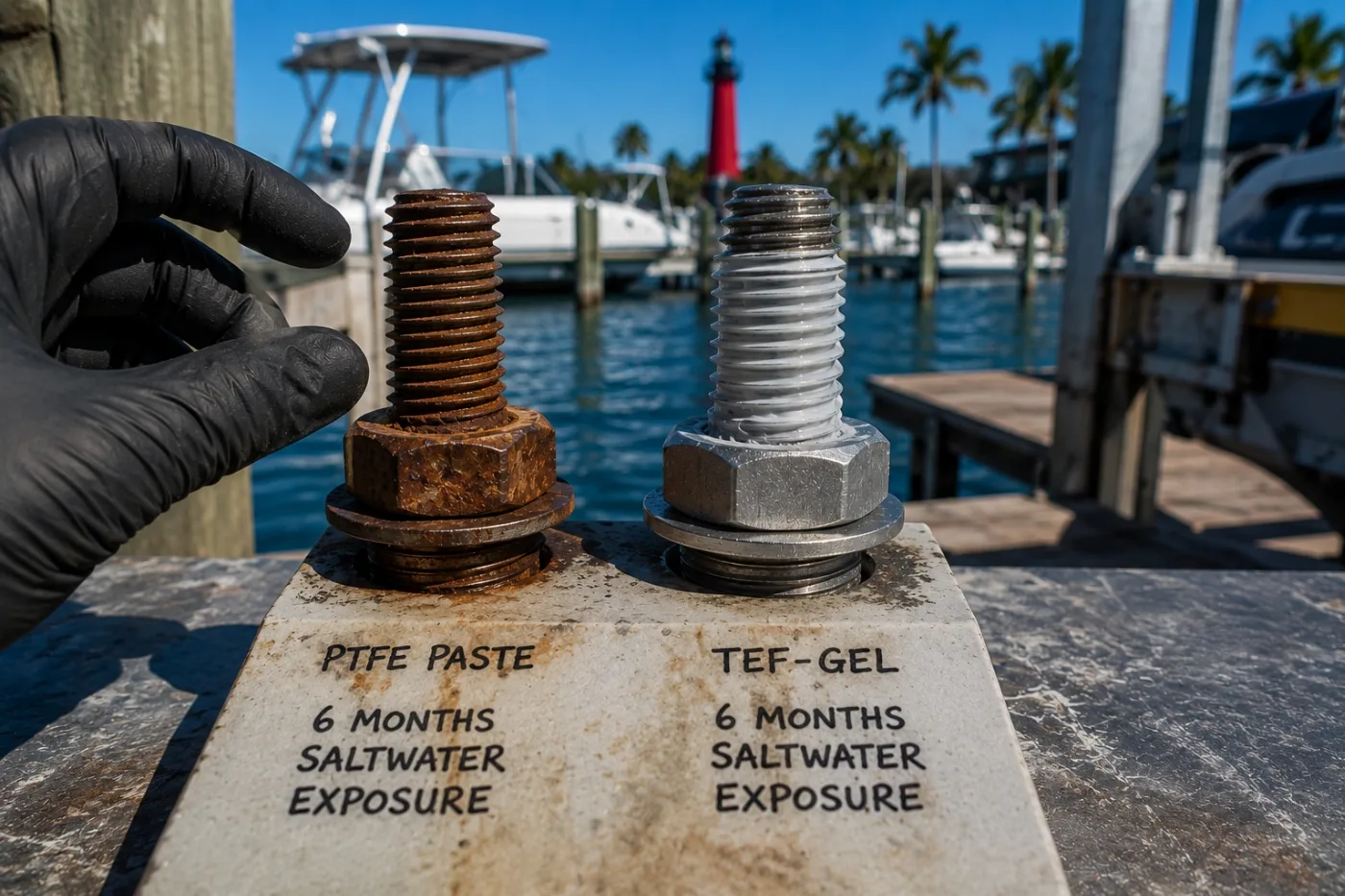
Six months of saltwater exposure is enough time for corrosion problems to become obvious on poorly protected marine hardware. Tef-Gel is designed to keep saltwater electrolytes away from metal interfaces while preventing galling and seizing. For captains operating around the Jupiter Inlet Lighthouse, the real question is whether that protective barrier stays where it was applied.
If you are preparing hardware for another season near the Jupiter Riverwalk, call (561) 320-3522 or contact Jupiter Boat Supply for help choosing the right Tef-Gel size for onboard maintenance.
For boats running around DuBois Park, Jupiter Boat Supply recommends Ultra Tef-Gel anywhere saltwater reaches joining metals. There is not a published controlled six-month treated-versus-untreated test from Jupiter Boat Supply that we can honestly present as our own, but the product specifications and independent marine testing give captains solid evidence about what to expect.
What Would a Proper Six-Month Saltwater Test Compare?
A useful corrosion comparison starts with identical hardware.
Take stainless steel fasteners installed into aluminum fittings, one of the most common dissimilar-metal combinations on a boat. Apply Tef-Gel thoroughly to one set of threads and mating surfaces while leaving the comparison set untreated. Both sets then need the same exposure to saltwater, humidity, temperature, and service conditions.
At the six-month inspection, the useful questions are straightforward:
- Is there visible corrosion around the untreated hardware?
- Is there white aluminum oxide or rust staining?
- Do the fasteners back out normally?
- Has either set begun to seize or gall?
- Is corrosion spreading around the metal interface?
- Does the treated joint still contain a protective film?
That is the kind of comparison that produces meaningful evidence. Changing hardware types, exposure conditions, or installation torque between samples would make the result much less useful.
What Does Existing Testing Tell Us?
Independent marine testing supports Tef-Gel's ability to protect metal and prevent seizing.
Practical Sailor tested Tef-Gel on several types of metal coupons for corrosion resistance, washout, and heat performance. The testers reported strong corrosion protection and found that Tef-Gel was the only tested product that still allowed fully tightened metal coupons to rotate in place.
That last point matters for working boats.
Corrosion prevention is not only about keeping a fitting looking clean. Captains and technicians need hardware to come apart during service instead of turning a routine repair into hours of drilling, cutting, and extracting seized fasteners.
Jupiter Boat Supply describes the same core benefits for Ultra Tef-Gel: protection against electrolytic corrosion, galling, seizing, and friction welding.
Why Does the Barrier Hold Up?
Tef-Gel contains 40 percent solid PTFE within the thread interface and no volatile solvents.
The lack of volatile solvents is important because the product is designed not to evaporate, dry out, or disappear from the joint over time. The manufacturer also describes the formula as waterproof and resistant to saltwater, freshwater, detergents, and UV exposure.
That gives the gel a simple job: stay between the metal surfaces and prevent saltwater electrolytes from reaching the interface.
Without that electrolyte, the galvanic reaction between dissimilar metals is interrupted.
This is especially important where stainless steel hardware contacts aluminum. Left unprotected in a marine environment, that combination can produce corrosion around the aluminum while the fastener progressively becomes harder to remove.
What Should You Look for at the Six-Month Inspection?
Start visually, then test serviceability.
Untreated hardware may show discoloration, rust bleed from surrounding components, white oxidation around aluminum, pitting, or deposits near the fastener head. The exact appearance depends on the metals and exposure.
Then try disassembly.
A properly treated connection should remain serviceable. Tef-Gel is specifically formulated to prevent galling and seizing, so the fastener should not feel bonded into the fitting simply because it spent months in a saltwater environment.
That does not mean every treated fastener will look factory new forever. Surface contamination and corrosion elsewhere on the assembly can still occur.
The more useful result is what happens at the protected interface. Can the hardware be removed without damage? Is the mating surface still protected? Has galvanic attack been limited where Tef-Gel was applied?
No Galling or Bonding Can Save Hours Later
Captains know the real cost of corrosion shows up during maintenance.
A seized bolt rarely fails at a convenient time. It appears during a pump replacement, electronics upgrade, engine service, bracket repair, or haul-out when the job already has a schedule.
If the fastener backs out cleanly, the service continues.
If stainless has galled or effectively bonded into the assembly, the job may require extraction tools, drilling, replacement hardware, or repair to the surrounding material.
That is why anti-seize performance matters just as much as visible rust prevention. Tef-Gel is designed to keep threaded assemblies removable while protecting the metal interface from corrosion.
Which Size Should You Keep Aboard?
For an owner or captain handling normal onboard maintenance, the Tef Gel - TG-1 (20cc tube) is the practical choice.
Twenty cubic centimeters is enough for many individual fasteners, brackets, electrical contacts, and fittings because the product is applied directly where the surfaces meet. The tube is also easy to keep in a maintenance kit without dedicating much storage space.
For yards, professional crews, refits, and vessels with frequent hardware work, the Tef Gel - TG-16 (16oz tub) makes more sense. It contains the same corrosion-protection product in a bulk format suited to repeated use.
The question is not which version performs better. It is how much you will actually use.
Treat Hardware Before Corrosion Becomes the Test
Waiting six months to see whether an untreated fastener corrodes is an interesting experiment, but it is not a good maintenance strategy on critical boat hardware.
Tef-Gel works best when it is applied during installation, before saltwater reaches the mating surfaces. Clean away existing corrosion and contamination, coat the contact areas thoroughly, then assemble the hardware so the product creates a continuous barrier.
Inspect treated connections during routine service. When a fastener is removed, clean and reapply Tef-Gel before reassembly.
To stock the right amount of Tef-Gel for your vessel before corrosion creates the next maintenance problem, call (561) 320-3522 or reach out to Jupiter Boat Supply for product guidance.